Heavy Lifting News
Case Studies on Innovative Problem Solving
Encore Performance: Bush & Burchett’s Second Bridge Launch
08/07/2026

By Mike Beres
Vice President
Engineered Rigging
When Bush & Burchett Inc. partnered with Engineered Rigging on the first incremental bridge launch in the Bluegrass State, it resulted in the tallest bridge in Kentucky. The Pond Creek Bridge stands 324 feet (98.8 meters) above the valley floor. “This was the first time a girder launch has ever been performed in Kentucky, and I was glad to be a part of it,” said Paul Burchett, co-founder of Bush & Burchett. “We would definitely use the approach again if the conditions called for it.”
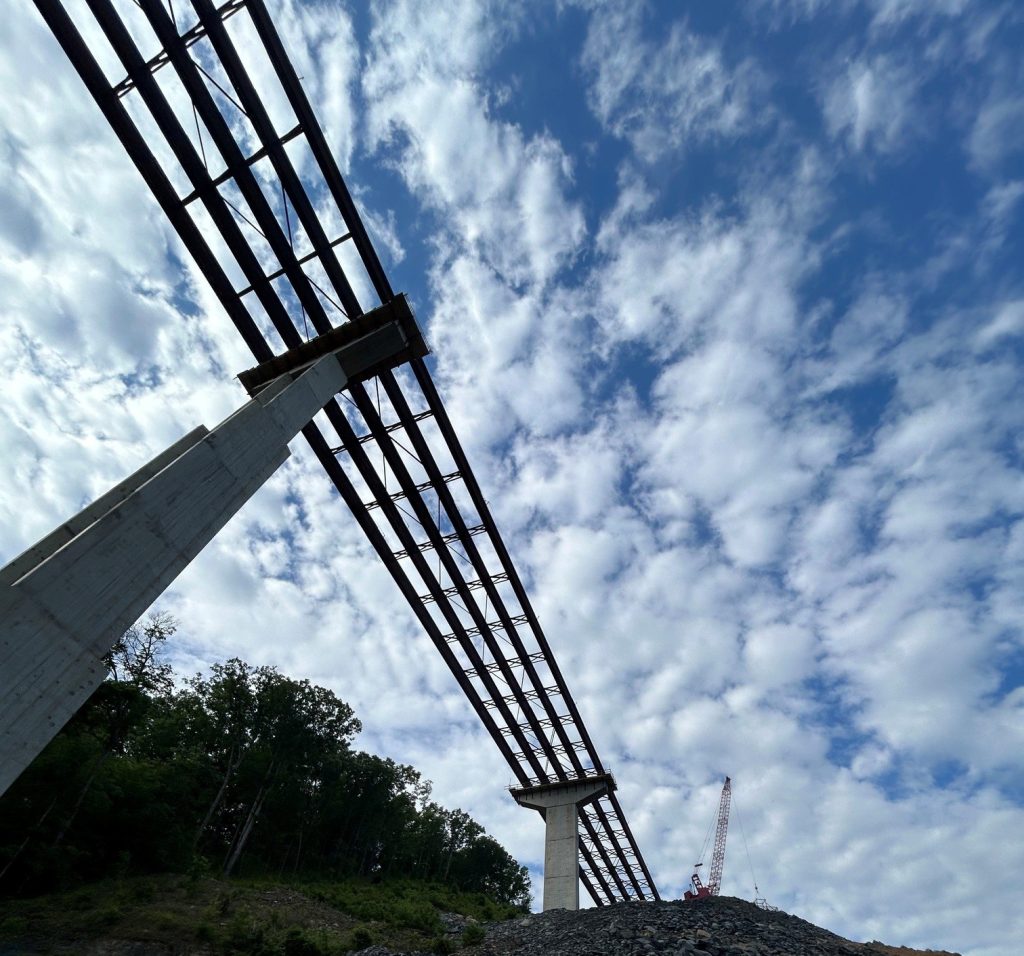
It wasn’t long before similar conditions arose again. In Spring 2026, Bush & Burchett launched the Salt Lick Creek Bridge as part of the Kentucky Transportation Cabinet’s (KYTC) US 127 Corridor Project, a $105 million phase that realigns six miles of highway around Wolf Creek Dam in Russell and Clinton counties. When completed later this year, the new bridge will span 1,275 feet (388 meters) with piers over 200 feet (61 meters) high.
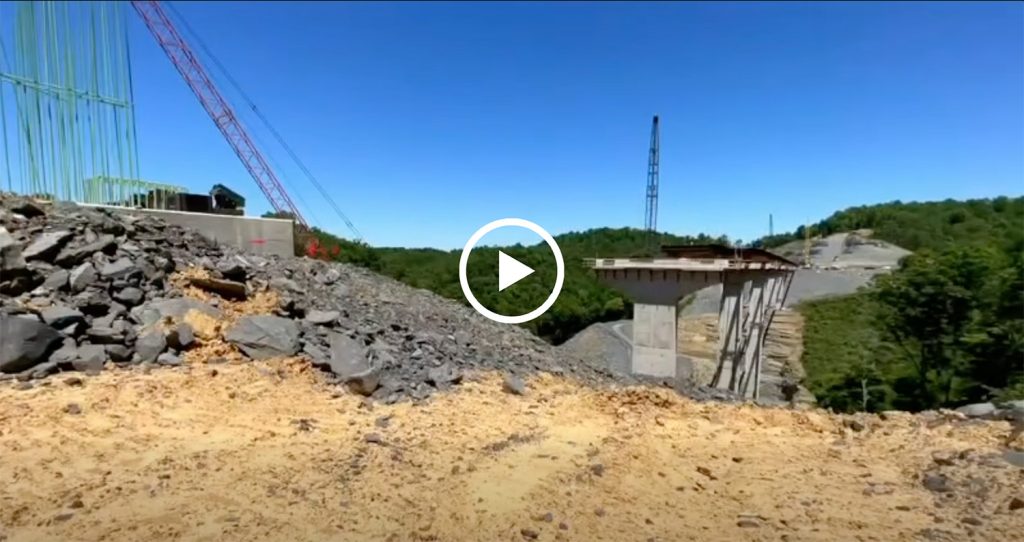
Why was bridge launching used instead of traditional bridge construction with a crane? In both situations, the topography demanded it. The construction sites were in remote areas where the ground falls away sharply beneath the pier lines, leaving no practical footing for conventional crane erection. At Pond Creek, the numbers tell the story: a bridge 324 feet tall but only 1,000 feet (304.8 meters) long, with slopes so severe that erecting from below was nearly impossible. The Salt Lick Creek terrain was just as unforgiving as shown in this footage from Palmer Engineering, the Corridor Project’s design and engineering firm.
Rather than lifting girders from below, Bush & Burchett assembled each steel superstructure on the embankment behind the abutment known as the launch bay. From there, a strand jack system supplied by Engineered Rigging took over. Two 70-ton Enerpac strand jacks anchored to an auxiliary launching structure at the abutment (see photo below) and connected via strand through a launch tail with the strand load anchor pinned to it, gripped bundles of high-strength steel strand and powered the superstructure forward in a caterpillar rhythm: grip, pull, release, retract and regrip. Hydraulic power units supplied oil to the jacks while the Smart Box, the system’s proprietary control platform, enabled a single operator to run both jacks in perfect synchronization from a laptop. Strand guides curved the strand bundles from the top of strand jacks into strand recoilers which collected the spent strand as the bridge advanced. During the move, the girders traveled on Hilman rollers. After each section reached the next pier and cleared the launch bay, crews assembled the next section behind it, and the bridge grew outward over the valley, pull by pull. Watch the Salt Lick Creek launch in motion in this KYTC video.
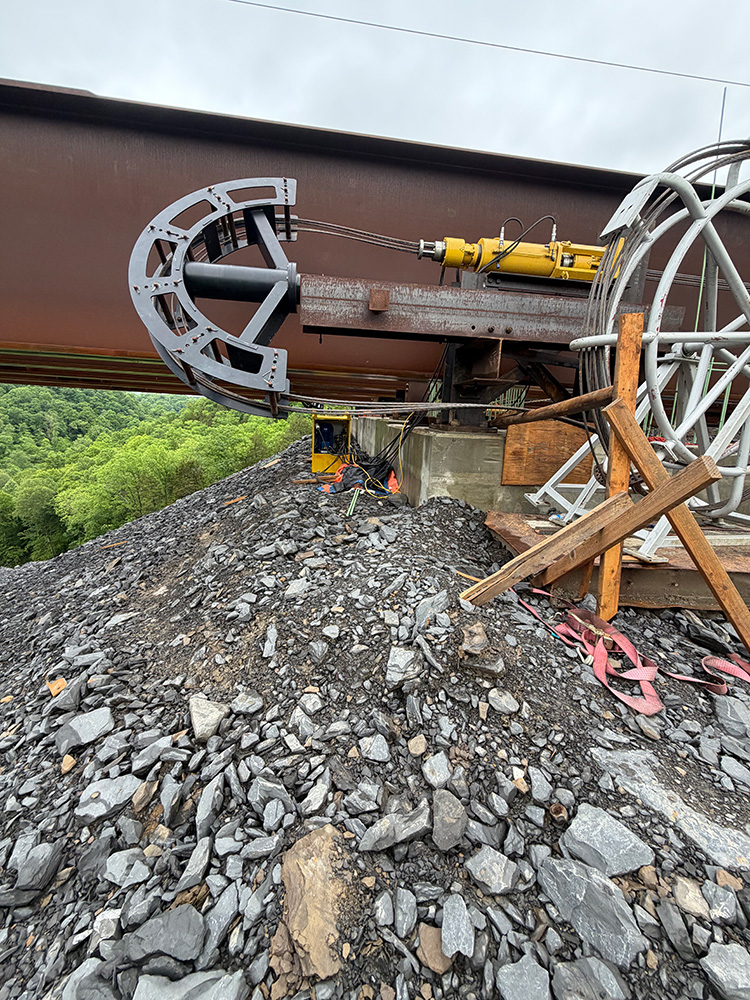
Operations this complex are exactly where a proven process and trusted equipment earn their keep. Bush & Burchett brought field experience developed during the Pond Creek Bridge launch, and Engineered Rigging supplied the same sophisticated strand jack system that proved itself during that project.
“After the successful Pond Creek launch, we knew this was a method that we would like to use again. When we got the Salt Lick Creek bridge, we immediately knew that an incremental bridge launch was once again the best option. Having done this once before, our experience on the first bridge allowed this launch to go even smoother. It’s a really cool method of constructing steel girders,” explained Paul Burchett. “Our partnership with Stantec and Engineered Rigging on both projects has been fantastic. We are already in the process of working on our next structure that we will launch around 2029 and look forward to working with Engineered Rigging and their expert, professional team again on that one.”
Engineered Rigging’s contribution to the project extended beyond the equipment rental. An experienced ER technician worked on site during each launch, providing a deep understanding of the strand jack system, assisting with setup and monitoring the operation to confirm everything ran smoothly according to plan.
“Onsite technical support is a value-added service that puts our clients at ease when high-tech equipment is used in a demanding operation like a bridge launch,” said Mike Beres, Vice President of Engineered Rigging.
The Salt Lick Creek Bridge remains on track for completion by the end of 2026 and will carry the new alignment of US 127 across some of southern Kentucky’s most challenging terrain. We applaud Bush & Burchett for their repeat performance on a bridge launch!
What Is a Bridge Launch?
Conventional bridge construction is built from below: girders arrive by truck, and cranes lift them onto the piers, piece by piece and span by span. This approach requires equipment access along the length of the structure and often temporary supports between the piers. Incremental launching is a bridge construction method that flips conventional erection on its head. The superstructure takes shape in one concentrated assembly area on solid ground, then advances over the obstacle using its own steel. No matter what lies below, an unforgiving valley, a busy waterway or an active rail corridor, a launch takes the obstacle out of the equation.
The technique, formally known as the Incremental Launching Method (ILM), was developed in Europe in the 1960s. Used worldwide, it has historically been rare in the United States. That is changing. With roughly 40% of American bridges now more than 40 years old against a 50-year design life, [1] transportation agencies are prioritizing accelerated bridge construction techniques that replace aging structures with minimal disruption. Bridge launching sits squarely in that toolbox.
At the US 127 crossing, the steep terrain made launching one of the only feasible approaches. However, research sponsored by the National Cooperative Highway Research Program found the method earns consideration even where conventional erection is possible, citing minimal disturbance to the surroundings, a concentrated work area for superstructure assembly and improved worker safety from erecting the structure at ground level rather than at height. The approach also reflects the context-sensitive design philosophy Palmer Engineering brought to the corridor: design solutions that balance infrastructure improvements with environmental stewardship and community needs.
[1]Federal Highway Administration, “States Across the Country Implement Accelerated Bridge Construction,” Work Zone Management Program.
Why Strand Jacks?
Strand jacks have become the standard tool for bridge launches worldwide, and the Pond Creek and Salt Lick Creek launchings illustrates why. A strand jack is essentially a linear winch: a hydraulic cylinder that advances a bundle of steel strand, gripping with wedge anchors as it strokes. This tool can lift, lower and hold a heavy load while delivering significant advantages:
- Compact Footprint: Strand jacks are small but mighty, with one of the highest capacity-to-size ratios in heavy lifting. The entire pulling system stages on the abutment, on ground the project already prepared, with no crane pads, no assembly areas and no reach limits to engineer around. That compactness matters most on remote sites like the trio of Kentucky bridge launches, where every piece of equipment must travel rural roads and steep grades just to reach the work.
- Precision: Hydraulic strokes advance the span in controlled increments while the operator monitors the launch of each bridge section in real time, inch by inch, with the ability to pause, hold or adjust at any point in the pull.
- Synchronization: With both jacks governed by one operator through the Smart Box, the pulling force stays balanced across the structure through every stroke, keeping the superstructure tracking true across hundreds of feet of travel. Additionally the platform scales: a single operator can synchronize and manage up to 60 Enerpac strand jacks from one laptop, capability far beyond what these launches require.
- Built-In Safety: The wedges that grip the strand are self-locking, so the load is held mechanically between strokes and stays held even if hydraulic pressure is lost. The Smart Box adds another layer of protection by letting the operator run the system away from the load, keeping people clear while the steel moves.
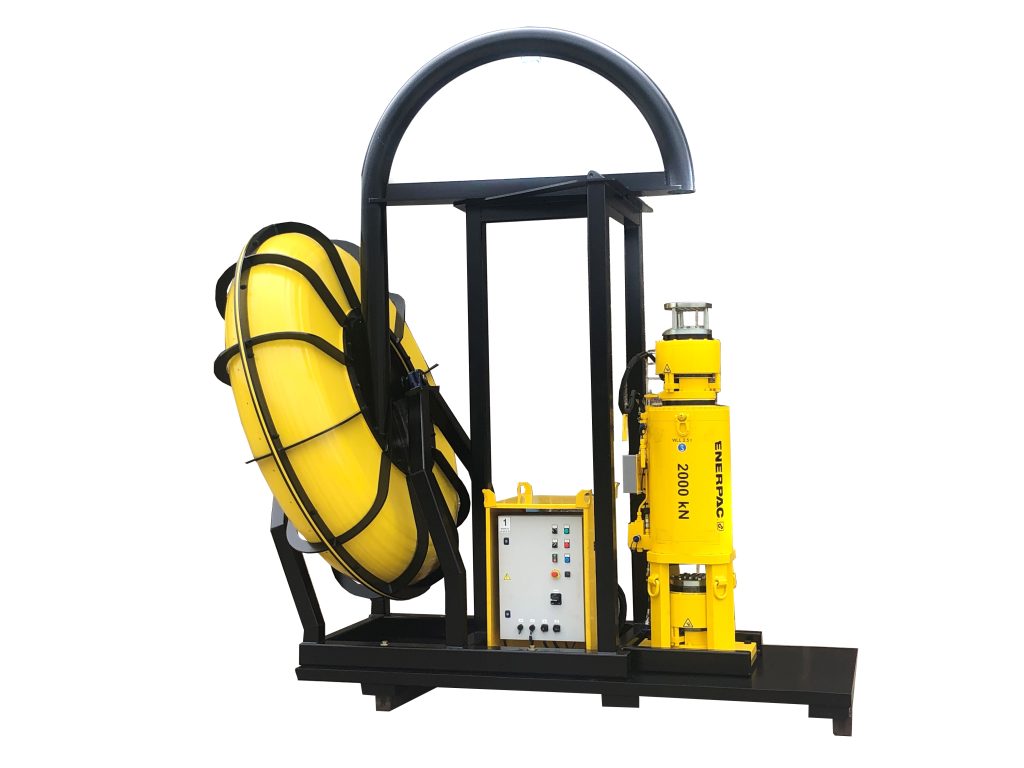
These features make strand jacks indispensable for a variety of complex projects beyond bridge launches. Read about how Engineered Rigging’s strand jacks were used in the Pennsylvania Turnpike’s most ambitious infrastructure project, a power plant’s HRSG harp replacement and the Army Corps of Engineers’ retrieval of WWII miter gates from the St. Mary’s River.