Heavy Lifting News™
Case Studies on Innovative Problem Solving
The Pennsylvania Turnpike's Most Ambitious Infrastructure Project
Strand Jacks Lower 330,000 Pounds of Bridge Falsework
06/24/2026

By Mike Beres
Vice President
Engineered Rigging
The Beaver River Bridge Replacement is no ordinary infrastructure improvement project. The largest contract in Pennsylvania Turnpike Commission history requires the construction of two cast-in-place segmental bridges, each 1,645 feet long, 70 feet wide and 200 feet high. Access to the river in that area is “pretty close to impossible” according to the Turnpike’s Project Manager, as it had no banks nor road access. When Fay, S&B USA Construction (Fay), was selected as the general contractor for the $282 million project, it had to overcome the terrain and several other challenges. Engineered Rigging was able to provide a solution for one of them.
The Challenge
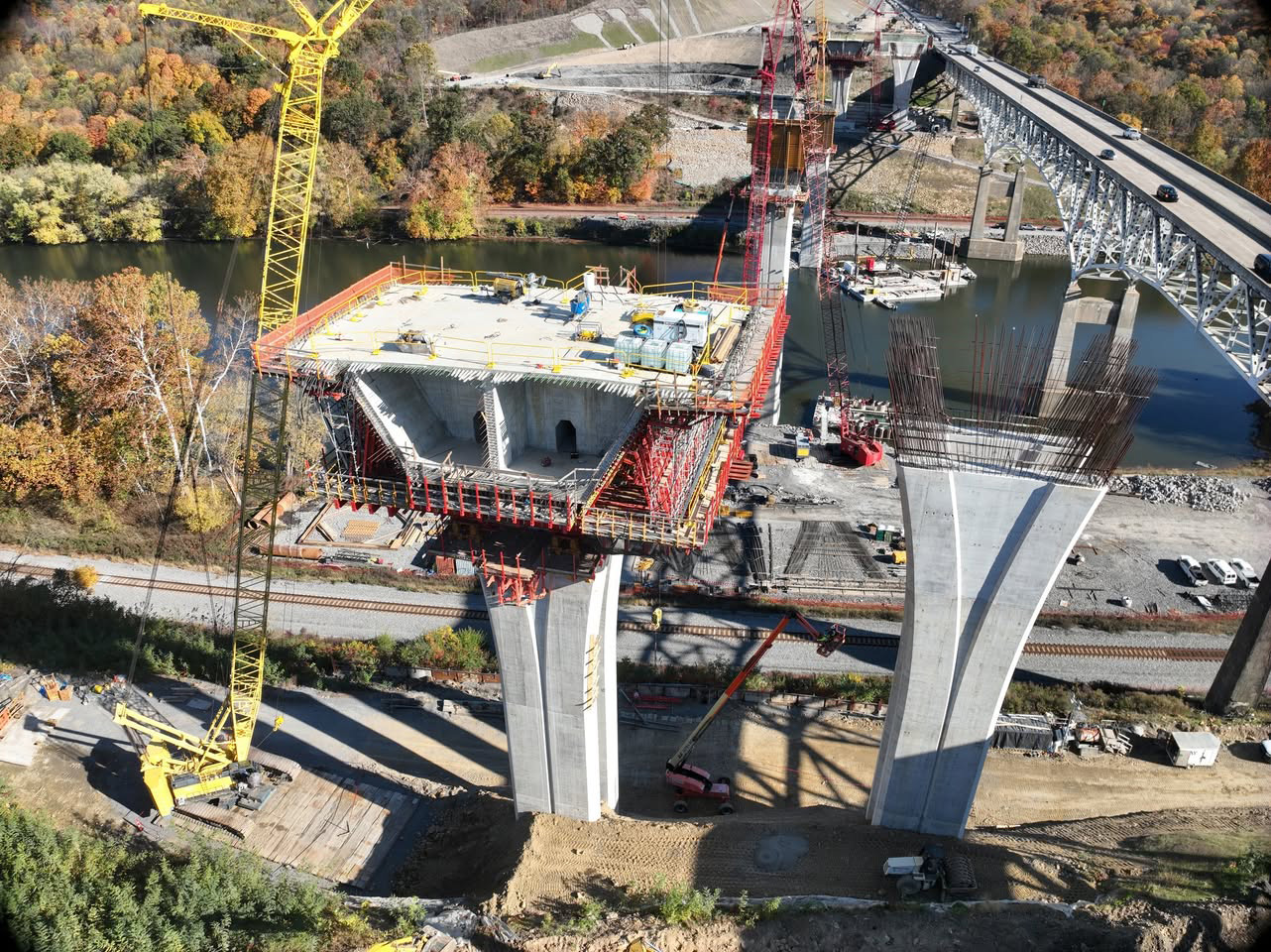
Early in the process, concrete pier tables had to be constructed on top of each bridge pier. These 74 feet by 40.5 feet pier tables would serve as a stable foundation, counterweight and anchor point for the heavy machinery used to cast in place the concrete bridge segments from each end of the pier tables. To construct the pier tables, massive falsework was erected and 810 yards of concrete was pumped into the formwork (see photo above). Once the concrete was cured, the falsework had to be removed which entailed lowering 330,000 pounds of steel as much as 200 feet so that the equipment could be safely disassembled at ground level. Fay was seeking a rentable solution that could deliver in these demanding conditions.
There are several factors that Engineered Rigging’s heavy lifting experts considered when identifying the ideal equipment for this job:
- Portability: The equipment needs to be easy to relocate to repeat the lowering process for each of the six piers.
- Multi-Point Lift: Given the size and weight of the load, and the fact that the massive falsework must be level during the descent, multiple connection points were needed to ensure the safety of the crew and the falsework.
- Precision Control: There is a lot that can occur during a 200-foot, incremental descent, including high winds, specific sequencing and tight tolerances, so real-time computer monitoring and synchronization of each connection point is critical to the project’s success.
- Durability: The equipment needs to withstand exposure to large temperature fluctuations, rain, snow, winds and ice accumulation during construction season in western Pennsylvania.
Given these requirements, a high-tech solution was crucial. Engineered Rigging recommended a synchronized incremental lowering system comprised of four Enerpac 70-ton strand jacks with equipped strand guides for strand management and powered by electric-driven hydraulic power packs connected to an up-station diesel generator. Strand jack systems are well-suited for bridge construction because they provide synchronous, incremental movement and pack a lot of capacity in a relatively small footprint. With load monitoring available on each jack and Enerpac’s SCC-Smart Cylinder Control System, a single operator can simultaneously monitor and adjust the load distribution of up to 60 strand jacks. Strand jacks are also highly portable, making them ideal for bridge construction. Engineered Rigging’s proposed solution fulfilled every requirement for this portion of the Beaver Bridge project.
Tim Sippey, Fay’s Superintendent, had experience working with strand jacks. However, the advanced models from Engineered Rigging’s fleet were a significant upgrade. He explained, “The strand jacks we were familiar with were manual. Engineered Rigging’s models had computer controls that allowed us to monitor the load on each jack and synchronize the lowering of the pier cap falsework. We were able to complete the project with less manpower that is typically required for a job of this size.”
In addition to saving time and manhours, Engineered Rigging’s strand jacks optimized the safety of the crew and the load with real-time computer monitoring, precise synchronous control and mechanical wedges which mechanically lock the load in place in the event of an issue. When conditions demand, the wedges can be engaged to support the load, even overnight if needed.
Austin Uric, E.I.T., Project Engineer at Fay, has been dedicated to the Beaver River Bridge project for the past three and a half years. He appreciated the performance and safety features, saying “Engineered Rigging’s strand jacks minimized potential error from the process.”
Rental from ER Includes Peace of Mind
Operating equipment for the first time can be daunting, but Engineered Rigging’s experts provide hands-on training to ensure that clients can safely set up and operate the modern machines. For this project, Engineered Rigging’s Vice President Mike Beres provided training as well as technical support (onsite and remote) throughout the project.
“The lowering of the first pier cap took us a full work shift. It went smoothly, which gave my crew confidence in the equipment and their abilities to operate it. By the third pier, we were able to lower the pier cap falsework in one half of a work shift,” said Sippey.
Fay, appreciated having Mike’s expertise just a phone call away throughout the entire operation. Sippey said, “Mike Beres was always immediately responsive to our questions.”
Rent Versus Buy
A 70-ton strand jack system is purpose-built for high-capacity precision lifts that require synchronization of multiple lifting points. Purchasing and maintaining a system of this kind would carry substantial cost and operational overhead beyond this project’s budget.
Renting from Engineered Rigging gave Fay, access to an innovative, field-ready system, including training and technical support, without the capital outlay or long-term ownership responsibilities. It also gave the contractor flexibility to scale the deployment to the project’s specific needs. Up front conversations about a pause in construction of the eight pier tables allowed Engineered Rigging to work with Fay, to leave the equipment on site until work resumed.
For Engineered Rigging, the project was a natural fit. Strand jack systems have long been part of the company’s civil construction equipment portfolio, and Engineered Rigging has deployed strand jacks on numerous bridge projects, including the tallest bridge in Kentucky, the Cline Avenue Bridge, the Wittpenn Bridge in New Jersey, the McClugage Bridge in Illinois, and the Panther Island Bridges in Texas.
“Strand jacks are one of Engineered Rigging’s most popular rentals because of their power, portability and versatility,” explained Beres. The company has used them at industrial plants, atop a port crane and inside of mines. He continued, “Our team loves supporting this equipment thanks to the endless variety of applications.”
Featured Equipment: STRAND JACKS
Strand jacks are available (rental or purchase) from Engineered Rigging in capacities ranging from 20 tons to over 1,400 tons per jack. The systems support synchronous lifting, incremental lowering, and precise load positioning for civil construction, industrial and energy sector applications.
- Compact footprint
- Powered by diesel driven hydraulic power packs
- SCC-Smart Cylinder Control System ensures precision control of synchronous lifting and lowering operations by a single operator from a central location for increased safety
- Automated locking / unlocking operation
- Telescopic strand guide pipes prevent bird caging
- Internal components are coated with Lunac, an anti-corrosion coating, making it suitable for marine environments
- Lloyds Witness Tested to 125% of maximum working load
- Capacity is based on 2.5 minimum safety factor over strand breaking load
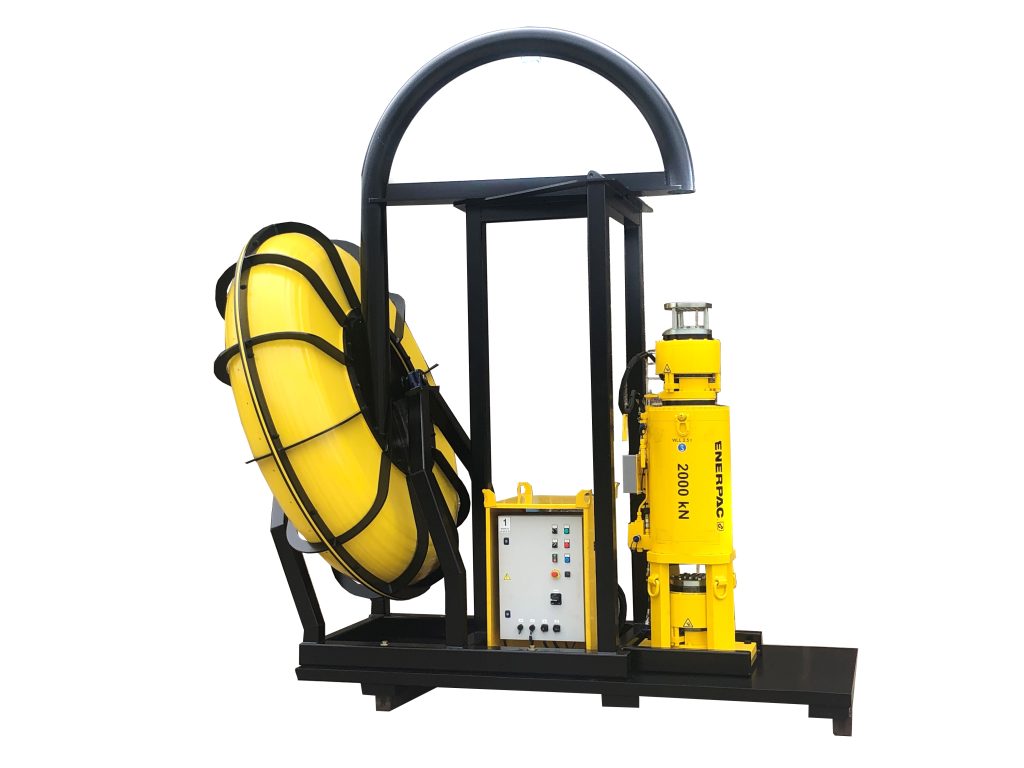
HSL7006 Hydraulic Strand Jack
Maximum Operating Pressure
5,000 psi (350 bar)
Capacity
79 imperial tons (70 metric tons)
Strand Diameter
0.62 in (15.7 mm)
Number of Strands
7
Stroke
18.9 in (480 mm)
This case study was developed in collaboration with Fay, S&B USA Construction. Project data sourced from publicly available project information.