Gantry Sizing: How Much? How Far? How Fast?
08/21/2024

By Mike Beres
Vice President
Engineered Rigging
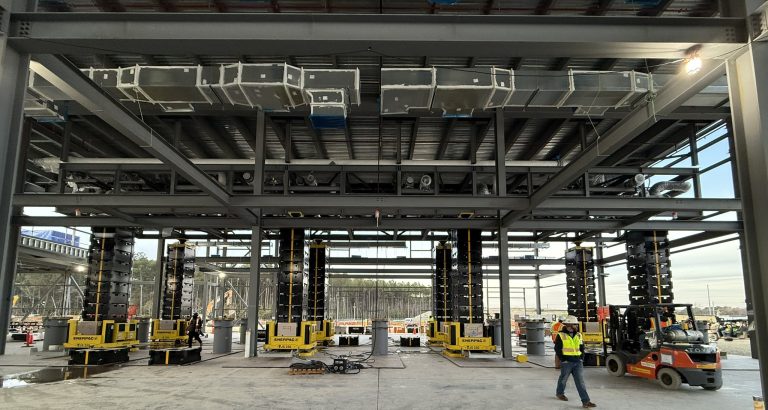
Hydraulic gantries are a popular solution when a crane is not practical. They can lift heavy loads weighing 45 to 11,78 tons to heights up to 39.38 feet. At first glance, choosing the right size gantry for your heavy lift project seems simple. You need to lift 400 tons 25 feet high, so you rent a 500-ton gantry. Right? Maybe not.
There is a danger of oversimplification. Gantries are designed so that lift capacity diminishes at each stage. For example, Enerpac’s SBL500 Telescopic Gantry can lift 550 tons to 25 feet. However, when the load is lifted into Stage 3, lift capacity decreases to 330 tons. To lift a 400-ton load 25 feet high, the Enerpac SBL1100 would be a great choice. It can lift 450 tons to 39 feet. The SBL600 or SBL900 would also work in this case.
Before renting or buying a gantry, you should have specific information about the project:
- How much does the load weigh?
- What are the dimensions of the load?
- How high does the load need to be lifted?
- How far does the load travel?
- How fast can the item be moved?
- What are the site conditions?
- Will I need to side shift the load?
Before specifying a gantry in a bid, I recommend discussing the job requirements with an engineer. Why? Bigger isn’t always better and you can’t assume that a larger capacity will solve your problem. While a larger capacity gantry may solve a capacity issue, it may not fit in the space available on the job site. Additionally larger gantries still may not have enough capacity if the load is shifted along the length of gantry header beams. Taking the time to evaluate the project needs beforehand will help you avoid renting or buying a gantry that won’t be able to perform the lift. The last thing anyone wants is a costly project delay due to an improper equipment choice.
With the rollout of federal funds for infrastructure projects, many government agencies and civil construction contractors are beginning to explore gantries as a viable and affordable lifting solution for bridge projects. If you have not used a gantry before, let our experienced team help you get comfortable with the technology. Whether a quick on-line meeting or via an in-person walkdown, our team is available to answer your questions to determine if a gantry is the right equipment for the job. In addition, Engineered Rigging provides training either at our facility in Russellville, AR or at your site, whichever is preferred. On-site technical support is available during operation of the equipment as well to optimize safety and help address any project surprises.
Here are some additional questions to ask before you embark on purchasing or renting a gantry:
- Will the lifting and handling take place in multiple locations?
- Will the lifted range cross multiple stages of the gantry lift?
- Is the lifted weight shared equally by the gantry legs?
- Do you need a 3D model of the setup, or a lift plan developed by an engineer?
- How soon does the work need to be performed?
- Will an on-site technician be required?
- How far does the gantry need to be shipped from the equipment depot?
Answering these questions up front enables better application discussion, leading to a more accurate bill of materials and a successful lift. If you are curious about gantry applications, I invite you to explore our case studies or give me a call at 844-474-4448 ext. 104.
Divers used a dredge pump and clamshell bucket to remove 80-years-worth of muck, clay and silt that had settled on the gates. Once cleared, they cut four access holes into each gate. The holes were large enough to secure the rigging which was attached to the strand jack load anchors. With a combined lifting capacity of 616,000 pounds, the strand jacks were more than able to break the suction from the underlying mud and lift each gate.
Once each gate was raised out of the river, the Army positioned a barge underneath it. The strand jacks then lowered the gate onto the barge to be transported to a nearby boat basin for recycling.
“The mission went better than expected with no major surprises thanks to the continuous input from our experienced employees and support from SPO’s excellent equipment manufacturers and rental supply base,” said St. Marys River Section Engineering Technician Theodore Clark, as reported in an Army news article.
As a US Army veteran and a history buff, this project was special for me. Whether it’s helping the Army Corps of Engineers retrieve some long-lost lock gates or another unique challenge, it’s a good day when our customers use our equipment to find success. If you need assistance identifying a heavy lifting solution, please contact me or any of our experts listed below.