

Trend Spotting:
Purpose-Built Equipment Is on the Rise
09/17/2026

This article was originally published in American Cranes & Transport magazine.
For decades, the equipment selection process was simple: choose from a broad catalog of general-purpose heavy lifting and transport equipment and make the project plan fit the machine. In today’s marketplace, you are more likely to source purpose-built equipment from multiple brands.
What’s driving this trend? It’s a combination of a few factors. First is the increased complexity of today’s heavy lifts and machinery moves. Time and time again, contractors and plant managers face more confined worksites, heavier loads and tighter schedules with less margin for error. When challenged by these demands, general-use equipment often falls short.
Which leads us to modern-day affirmations of Plato’s wise words, “Necessity is the mother of invention.” Recent market disruptors tend to be smaller manufacturers who focus on creating a solution for a specific problem or set of conditions. Their goal is not to be a jack-of-all-trades. They set out to build a robust knowledge base which enables them to excel in a single or limited number of purpose-built products.
The science behind innovation backs this strategy. Research published in the Journal of Technology Transfer confirms that concentrating R&D on a single, specific challenge builds a deeper foundation of specialized knowledge, ultimately yielding more reliable, high-performing products.
Foxtrot Industrial is a sterling example. In 2021, Charles-Éric Raymond, Benoît Serrano-Parent and a group of fellow mechanical engineering students at the University of Sherbrooke embarked on a final-year project. They started by identifying a common problem in the industrial world: a general forklift’s footprint does not allow heavy loads to be maneuvered in locations with minimal space. The students quickly identified the parameters that would make or break their invention’s viability. It would have to be powerful enough to handle very heavy loads. It would need to be agile enough to navigate the narrow aisles, tight corridors and low clearance common in industrial facilities. It should be safer to operate than a forklift which has a high incident rate. The result was a low-profile, battery-powered and remote-controlled skate that could manage loads up to 20 tons. Charles-Éric and Benoît took that initial breakthrough design and launched Foxtrot. Today, the company has a line of robotic dollies with load capacities ranging from 10 to 60 tons. These models, built with specialized knowledge gained through focused effort, are engineered to manage floor gaps, cross thresholds and, in some cases, even lift a load before precisely moving it. By going deep on a very specific problem, Foxtrot has been able to innovate heavy load and machinery moves inside the challenging confines of industrial environments.
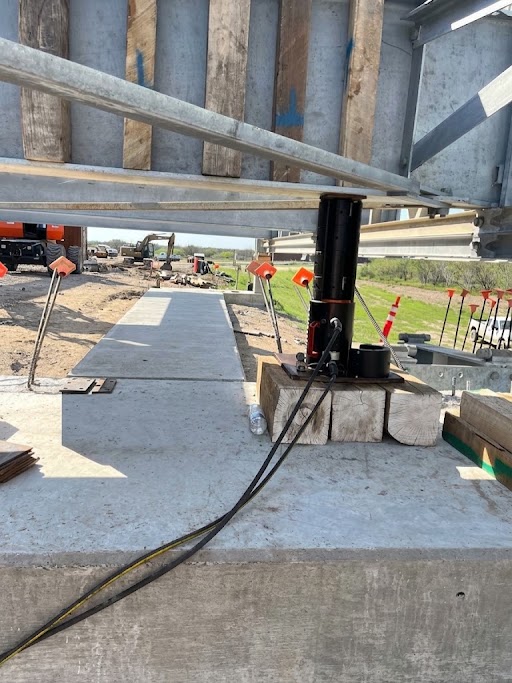
Another recent industry innovation was born from the same problem-solving strategy. For generations, the jacking and cribbing method was used to remove and replace power transformers weighing upwards of 400 to 600 tons. The process was slow, labor-intensive, prone to human error and safety risks. Holmatro, a manufacturer of hydraulic solutions based in The Netherlands, set out to modernize the process. They subsequently invented a new technology: a mechanical ring and puck system integrated with a hydraulic cylinder. As the cylinder extends to the end of its stroke, a technician inserts lightweight stacking rings around the cylinder rod. The engineered rings have documented load ratings and lock into position creating a stable, predictable, load-bearing column. Holmatro’s ring climbing cylinders expedite the lifting and lowering operation, optimize safety, reduce labor and remove the guesswork associated with manual cribbing.
It’s worth noting that a purpose-built solution can find purpose in other applications. While ring climbing cylinders were designed to move transformers, they are increasingly the tool-of-choice for incremental lifts of machinery and industrial components of all types.
Barnard Construction Company was one of the first adopters of the ring climbing cylinders after they were introduced in the U.S. in 2024. They used the equipment after a bridge launch. The bridge had a weight of almost 72 tons per corner totaling just over 286 tons, and it needed to be incrementally lowered approximately 38 inches. The original project plan called for jacking and fleeting using two large cribbing stacks and low-height cylinders. However, a jack and crib operation of this nature requires a lot of resetting and manual handling of heavy timbers and cylinders.
The project’s engineer, Will Stevenson, said, “As an innovator in our field, Barnard welcomes the opportunity to step outside of the box to realize efficiencies. The ring climbing cylinders provided a solution that saved time while maintaining Barnard’s commitment to quality and safety.”
When Standard Won’t Suffice
In some situations, even the largest assortment of standard models won’t fulfill a client’s unique needs. When seeking a new gantry for its headquarters in Takamatsu, Japan, Nippon Express knew only a customized solution would fulfill its load capacity and height needs and comply with Japan’s strict regulations related to the gantry’s size. The company contracted Officine CLP, the Italian manufacturer, to redesign its LG202 gantry to fit the government-mandated footprint. The gantry was designed, built and acceptance-tested at CLP’s workshop in Italy, then shipped and installed at the facility in Japan.
When a project demands a customized solution, after-market adaptations are another consideration. In these situations, a standard model is retrofit with customized parts to allow performance beyond its original capabilities. During the demolition of the 90-year-old Wittpenn Bridge in New Jersey, Enerpac 200-ton strand jacks were selected to meet the power, precision and portability needs of the project. However, the engineering plan called for the strand jacks to be inverted and secured to the bridge (see photo). Custom attachments called dog bones were fabricated out of steel to secure the strand jacks under the main span lift girders.

The Planning Payoff
When equipment is purpose-built for a specific application or customized to a project’s unique needs, there are several benefits. First, it saves time. When you have the proper tool available to get the job done, you optimize productivity and avoid wasting time on field improvisation. A project team that trusts its equipment to perform as specified can compress schedules that would otherwise carry time for contingency plans.
Second, it reduces the safety risks and uncertainty associated with using a tool in an unproven manner. It’s hard to assign a value to the confidence gained by the crew, the contractor and the project owner.
For facility managers, industrial construction contractors and anyone needing equipment to move a heavy load, the good news is that there are more options than ever before. Innovation and advanced technologies are leading to an increase in purpose-built and customized solutions that perform better, safer and faster. That’s a win-win for everyone.
